A thank you card is the smallest thing you can add to an order and one of the most powerful. It costs less than a coffee. It takes 30 seconds to tuck into a package. And it’s the one element of your customer experience that almost no competitor bothers with.
Here’s how to write, design, and use thank you cards in a way that actually drives repeat purchases and five-star reviews.
Why Thank You Cards Work
The psychology is straightforward: when someone does something nice for us, we feel a natural impulse to reciprocate. In business, this is called the reciprocity principle — and it’s one of the most reliable drivers of customer loyalty.
A handwritten (or handwritten-style) thank you card signals that a real person made and packed this order. That’s rare in a world of warehouses and automated emails. It creates a moment of human connection that customers remember and talk about.
What to Write on a Thank You Card
The biggest mistake: writing corporate-speak on a thank you card. “We appreciate your patronage” is not a thank you — it’s a form letter. Write like a person.
A good thank you card formula:
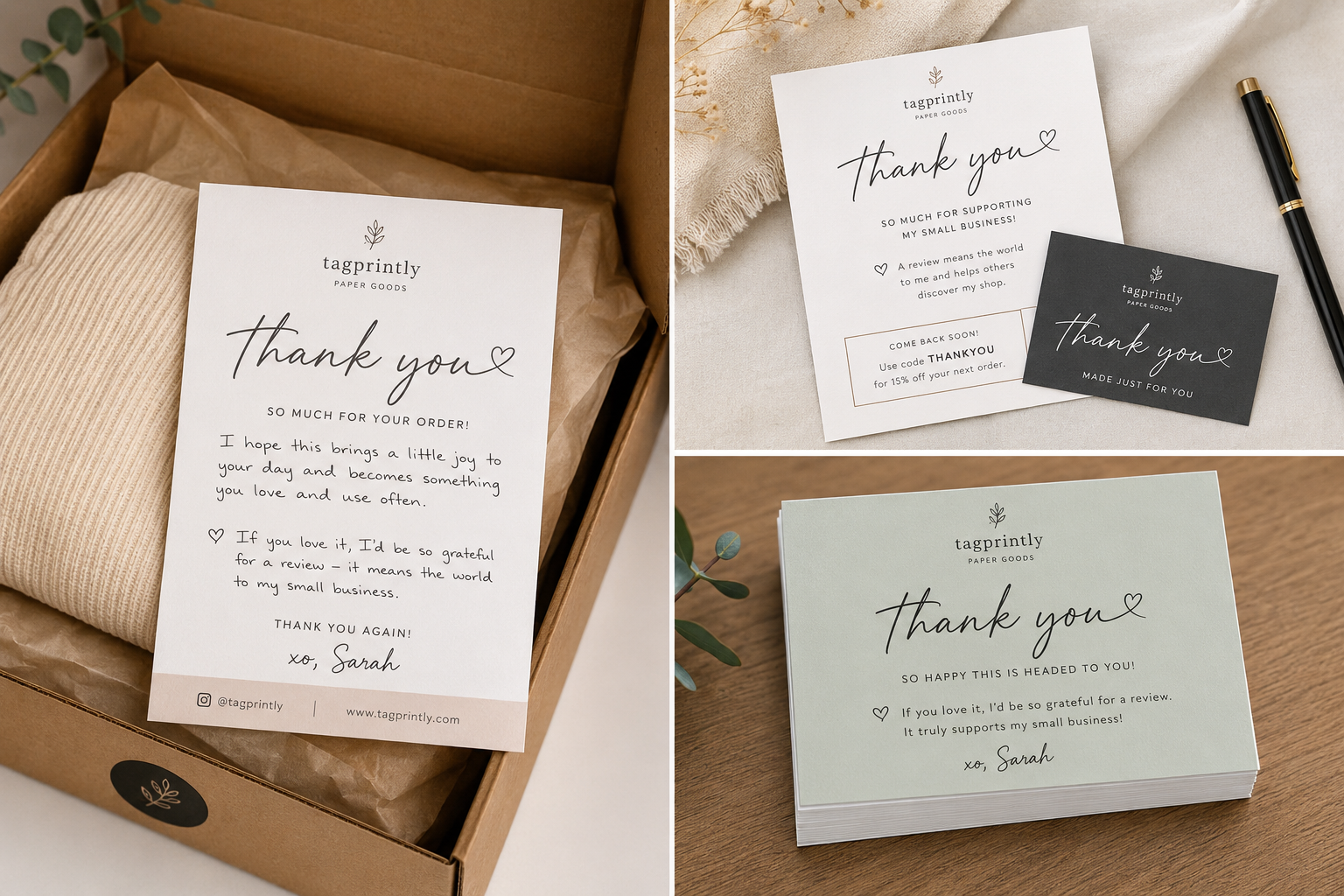
- Thank them specifically — “Thank you so much for your order!” or “So happy this is heading to you today.”
- Add something warm and personal — mention the season, a wish for how they’ll use the product, or just “I hope it makes you smile.”
- One soft call to action — “If you love it, I’d be so grateful for a review” or “Come back with code THANKYOU for 15% off.”
- Sign with your name — not “The TagPrintly Team.” Your actual name. It matters.
Design: Match Your Brand, Not the Occasion
Your thank you card should look like it belongs with the rest of your packaging. If your brand is minimal and monochromatic, don’t suddenly use a floral rainbow card. Consistency is what makes a brand look professional.
Elements of a well-designed thank you card:
- Your logo, small, at the top or bottom
- Brand colors (one or two, not more)
- Clean typography with clear hierarchy
- Enough white space that it doesn’t feel cluttered
- Space to handwrite a name or short personalisation
Size: A5 vs. Business Card
Two sizes work well for Etsy packaging:
- A6 (postcard size, 105x148mm) — substantial enough to feel like a proper card. Stands out in the box
- Business card size (85x55mm) — minimal footprint, easy to include in any order size. Less impactful but still effective
Avoid tiny cards (smaller than business card) — they feel like afterthoughts. If you’re going to include a card, make it worth seeing.
Printing Thank You Cards at Home
Printable thank you card templates (like those at TagPrintly) print on standard A4 paper, giving you 2 A6 cards per sheet. Print on 250–300gsm white card stock for a premium feel. Cut with a guillotine for clean edges.
For handwritten personalisation, leave a space in the design. A single handwritten line — even just the customer’s name — dramatically increases the card’s emotional impact.
FAQ
Should I include a thank you card in every order?
Yes, every time. Consistency is what turns a nice gesture into a brand experience. The moment you skip it for “small” orders is the moment a customer notices the absence.
Does a thank you card actually increase reviews?
Yes. Studies on e-commerce customer behavior consistently show that customers who receive a personal thank you note are more likely to leave a review than those who don’t. A soft, genuine ask on the card (“A review means the world to a small business”) is far more effective than a follow-up email.
Can I print thank you cards on a regular inkjet printer?
Yes. Print on the heaviest card stock your printer can handle (most inkjet printers manage up to 200–250gsm). Let the ink dry fully before stacking or handling. For laser-sharp text and professional results, a laser printer on 250gsm matte card gives the best output.